
Project archive guide. Technical instructions are awaiting hardware-team review; consult the documentation for your exact equipment.
Propellers
Propellers are the driving force behind an FPV drone’s lift and movement, converting motor torque into thrust. Their size, pitch, shape, and material directly affect flight performance, speed, efficiency, and maneuverability. Choosing the right propeller is crucial for balancing power draw, flight time, and handling characteristics, making them one of the most important components to tune for your specific flying style and build.
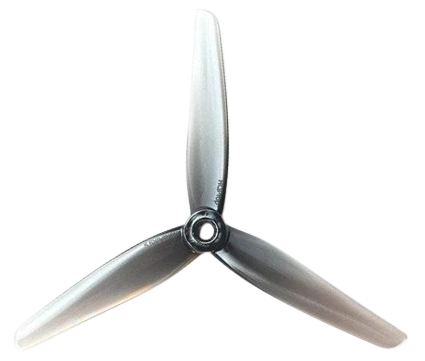
Important Definitions
Size
The overall diameter of the propeller, usually measured in inches.
Pitch
The angle of the blades, usually in inches of travel per revolution.
Blade Count
The number of blades affects thrust, efficiency, and handling.
Material
Common materials include plastic, carbon fiber, and nylon composite.
Blade Shape & Profile
The width, curvature, and tip design of blades influence grip, noise, and efficiency.
Hub Design
The center mounting area of the propeller, which must match your motor shaft type.
Size (Diameter)
The diameter of a propeller determines how much air it can move per revolution. Larger propellers generate more thrust and efficiency at lower RPMs, making them ideal for carrying heavier payloads or long-range flights. However, they require more torque from the motor, which increases current draw and heat. Smaller props are lighter, spin up faster, and offer more responsive control, making them better for racing and acrobatics. Why it matters: Matching prop size to motor power and flight style ensures you get the best balance of speed, efficiency, and control.
Pitch
Pitch measures the distance a propeller would theoretically travel in one revolution if it were moving through a solid medium. Higher-pitch props produce more forward speed but require more motor power, which can shorten battery life and increase heat. Lower-pitch props are easier on the motors, providing better efficiency and smooth throttle control but with less top speed. Why it matters: Choosing the right pitch helps optimize your drone for either endurance and smoothness or raw speed and acceleration.
Blade Count
The number of blades directly impacts thrust, smoothness, and efficiency. Two-blade props are the most efficient and allow motors to spin faster, giving high top-end speed with less current draw. Three-blade props add grip and stability in the air, especially in aggressive maneuvers, at the cost of slightly reduced efficiency. Four or more blades maximize thrust and stability but put the heaviest load on motors and batteries. Why it matters: Blade count is a balancing act between smooth handling, efficiency, and raw power output.
Material
Propeller material affects durability, stiffness, and responsiveness. Plastic props are cheap, lightweight, and flexible, making them beginner-friendly and more crash-resistant. Carbon fiber props are extremely stiff, which improves responsiveness and efficiency but can snap more easily in crashes and transmit more vibration to the frame. Nylon composite props offer a middle ground, with good durability and moderate stiffness. Why it matters: The right material can make your drone feel snappy and precise or soft and forgiving, depending on your needs.
Blade Shape & Profile
The width, curvature, and tip design of blades influence thrust, efficiency, and noise. Wide blades produce strong low-end thrust and quick acceleration but require more power to spin. Narrow blades are more efficient and put less strain on motors, making them great for endurance flying. Tip shape also matters — sharp tips can improve efficiency, while rounded tips reduce noise and improve durability. Why it matters: Blade shape fine-tunes how a propeller “feels” in flight and how it handles in different air conditions.
Hub Design
The hub is the center mounting area of the propeller that attaches to the motor shaft. Common types include T-mount (screws directly into the motor) and standard 5mm hole mount (secured with a nut). A strong, precisely machined hub helps maintain balance, reducing vibrations and preventing prop slippage during aggressive maneuvers. Why it matters: An unstable or mismatched hub can cause oscillations, motor wear, and even mid-flight propeller loss.
Propeller Deep Dive
Propeller Size
The diameter of the propeller, measured in inches, directly affects thrust and efficiency. Larger props move more air, generating more lift and efficiency for heavier drones, but require more power and can reduce agility. Smaller props spin faster, increasing responsiveness and maneuverability, but at the cost of flight time and top-end thrust.
Material
Plastic props are lightweight and inexpensive, making them ideal for beginners due to their flexibility and crash resistance. Carbon fiber props are stiffer, providing sharper response and efficiency, but are more brittle and can be dangerous in a crash. Nylon or reinforced composites balance durability with stiffness for versatile performance.
Blade Count
Two-blade props are efficient, produce less drag, and are ideal for long-range or endurance flights. Three-blade props strike a balance between smooth control and good thrust, popular for freestyle and racing. Four or more blades offer maximum grip and thrust in tight turns, but at the cost of higher current draw and reduced efficiency.
Propeller Rotation Direction
Propellers come in clockwise (CW) and counterclockwise (CCW) orientations, and FPV drones use a matched set to balance torque. Choosing the correct rotation pattern (standard or props-out) impacts debris movement, frame cleanliness, and takeoff stability.
Balance and Vibration
Unbalanced props can cause vibrations that reduce camera clarity and make the flight controller work harder. Using a prop balancer or selecting high-quality props minimizes vibrations for smoother footage and more stable flight performance.
Noise Levels
Blade shape, pitch, and count all affect prop noise. Fewer blades and lower pitch typically reduce sound, making them suitable for cinematic flying in noise-sensitive environments. High-pitch, multi-blade props tend to be louder due to higher air displacement.
Durability vs. Performance
Flexible props withstand impacts better, bending instead of breaking, but may lose efficiency at high loads. Rigid props offer better control and responsiveness, especially in racing, but are more prone to breaking during crashes.
Environmental Suitability
High-pitch or multi-blade props can improve grip and stability in windy conditions, while low-pitch, two-blade props maximize efficiency in calm weather. Choosing the right prop for the environment can significantly improve performance and flight time.