Project archive guide. Technical instructions are awaiting hardware-team review; consult the documentation for your exact equipment.
Brushless Motors
Brushless motors are the powerhouse of your drone. Unlike brushed motors, they use electronic commutation (instead of physical brushes) to spin the motor, making them more efficient, powerful, and durable — perfect for high-performance drone flight.
What Are They?
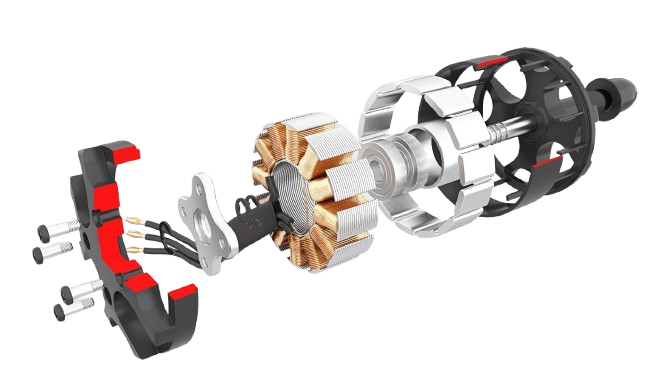
Brushless motors are the powerhouse of your drone. Unlike brushed motors, they use electronic commutation (instead of physical brushes) to spin the motor, making them more efficient, powerful, and durable — perfect for high-performance drone flight.
How Do They Work?
A brushless motor spins using magnets and electronic control instead of physical brushes. The rotor holds strong permanent magnets, while the stator has copper coils that become electromagnets when powered. An Electronic Speed Controller (ESC) sends timed pulses to the coils, making the magnets push and pull the rotor in a smooth spin.
Why Are Brushless Motors Used In Drones Instead of DC Motors?
Brushless motors are preferred over brushed DC motors in FPV drones for several key reasons:
- Brushless motors can produce more thrust for their size and weight, letting FPV drones
- accelerate faster and carry more gear without becoming sluggish.
- Less energy is lost as heat compared to brushed motors, meaning longer flight times on the same battery.
- No brushes to wear out, so they can run for hundreds of hours with minimal performance loss—important for pilots who fly often.
- Controlled by ESCs with precise, rapid timing, allowing instant RPM changes—critical for sharp turns, flips, and other FPV maneuvers.
- Can spin at extremely high RPMs without overheating, enabling the kind of fast racing speeds FPV is known for.
- Available in many sizes, KV ratings, and winding styles to match different drone builds, ultra-light racers or heavy long-range rigs.
Stator Diameter
The width of the stator (in mm) — larger diameters can deliver more power and torque.
Stator Height
The vertical size of the stator (in mm) — taller stators generally produce more torque.
Number of Windings
The times wire is wrapped around the stator — more windings increase torque but reduce RPM.
KV Rating
Indicates motor speed per volt applied — higher KV means faster RPM but less torque.
Stator Diameter
The diameter of the stator influences the leverage the magnetic field has over the rotor. Larger diameters produce more torque and power, but increase weight and power consumption.
Stator Height
The height of the stator affects torque output. Taller stators have more copper windings, which generate greater torque and sustained power, but may slightly reduce responsiveness and efficiency.
Number of Windings
This is the number of times the copper wire is wrapped around each stator tooth. More windings increase torque but reduce maximum RPM. Fewer windings allow higher RPM but at the cost of torque.
- High KV Motors (great than 1800KV): Spins faster, giving quick acceleration and responsiveness, good for racing and freestyle tricks. But gives you less torque and is louder.
- Low KV Motors (less than 1000KV): Spins slower but with more torque, which is better for carrying heavier payloads, flying long-range, or using bigger props. You’ll get better efficiency but less snappy response.
KV Rating
KV measures how many revolutions per minute (RPM) a motor spins per volt with no load. A higher KV motor spins faster but has less torque, making it ideal for lightweight, high-speed builds. Lower KV motors spin slower but deliver more torque, suited for heavy drones or long-range flights.
- High KV Motors (great than 1800KV): Spins faster, giving quick acceleration and responsiveness, good for racing and freestyle tricks. But gives you less torque and is louder.
- Low KV Motors (less than 1000KV): Spins slower but with more torque, which is better for carrying heavier payloads, flying long-range, or using bigger props. You’ll get better efficiency but less snappy response.
Number of Coils
Brushless motors typically have multiple coils (electromagnets) around the stator. More coils can provide smoother operation and better efficiency, but require more complex electronic control.